Overview
Timeline
July 2023 - November 2023
Role
Founding Product Designer, Art Director, Design System Manager
Summary
Klarity Software is a startup aiming to change the way that online sales happen between the customer and sales teams through the use of AI.
I joined at an early stage to serve as the foundational product designer. My role was to help define the product vision alongside the CTO while creating and iterating on the digital experience that our engineers could execute on. During my time with Klarity we created a working proof of concept before our product went live with three customers.
We gained ~50K ARR with another 300K forecasted. Despite the positive numbers, large amount of interest and several confirmed investor partners, the product and company were ultimately shelved in the winter of 2023 due to funding problems related to the ongoing tech industry downturn. The team is currently in the process of selling the technology.
68%
68% of B2B buyers avoid Salespeople until ready to sign.
70%
70% of the buyer's journey happens before they seek Sales engagement.
9/10
B2B buyers say online content has a strong effect on decisions.
Brief
Klarity addresses the disconnect between online buyers and salespeople. The image below, provided by Gartner, shows a typical B2B buyer’s journey. You can see how challenging it can be to align with your team, and find information without needing to contact a salesperson. It can take months of back and forth and digging into research and documentation to come to decision before you enter the tail end of the sales funnel.

Klarity lowers the barrier to information by allowing users to get answers directly from an AI powered research portal, minimizing reliance on sales personnel for answers. This can reduce the buyers journey up to 67% while creating a more pleasant experience for online buyers who prefer not to interact with sales reps. On the flip side Klarity provides more qualified leads and frees sales reps up to spend more time converting sales.
Exploring the Problem
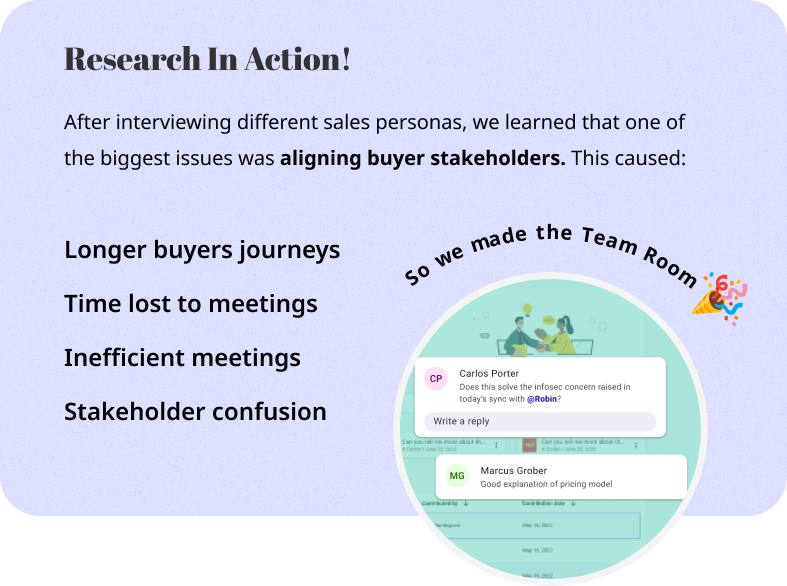
Over the course of my time with Klarity we were constantly conducting research and gathering information from stakeholders and potential users. This information was used to modify our roadmap and dream up new features while improving what we had already made. Due to the high amount of research, I’ll paint the broad strokes by describing some common methods we employed below.
Competitive Studies

Whenever I enter a new field or start on a new product/feature I like to do a quick competitive study and analysis. This involves systematically listing the features offered by competitors while noting both positive and negative aspects of their user experience (UX) and user interface (UI). I completed several rounds of competitive studies as our product evolved to both evaluate the baseline for user expectation, and to explore and learn about the current state of the industry. In the above image I targeted both digital sales rooms and AI tools to begin forming a vision for how those two product might be combined effectively.
Interviews
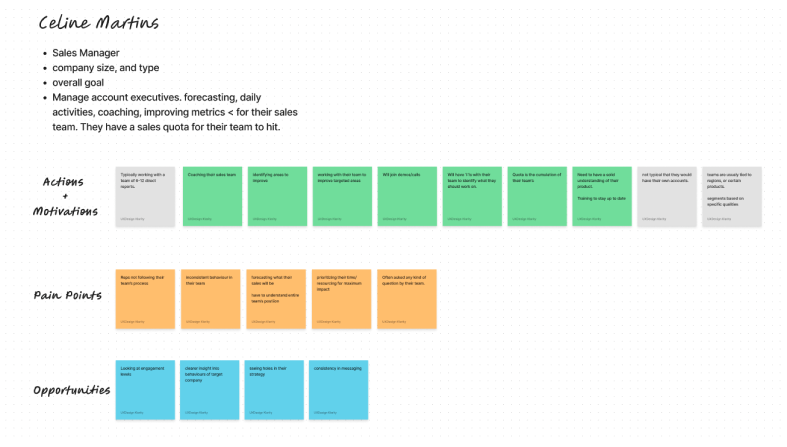
We had several opportunities to interview different types of users and stakeholders including: people working in the sales industry, industry experts, and potential users. Interview data was often collected and analysed in figjam, informing our product roadmap and assessing tool effectiveness. Although we weren’t able to gather significant usage data due to the timing of our launch, regular interviews enabled ongoing product refinement during development.
Concept Testing
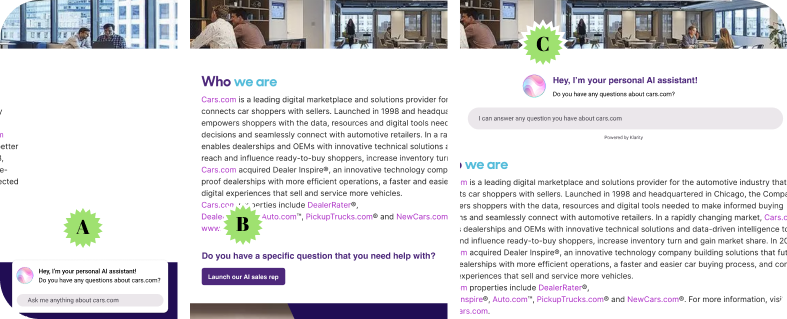
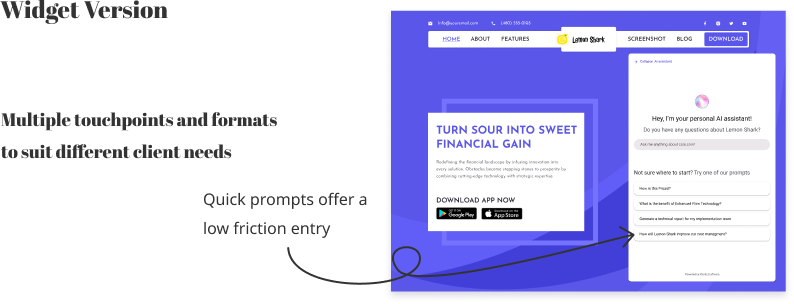
We often performed a few concept tests with potential customers in our sales funnel and with industry experts. We gathered feedback on features, usability and also how people felt about the general vibe of the tool. One feature that was heavily driven by concept testing was our Widget Tool. Because this tool would sit on the customers website we mocked up several ways that tool might look on a customer website and concept tested with potential customers. This helped us understand their goals an concerns with a tool that is moderately invasive on their website.
Card Sorting
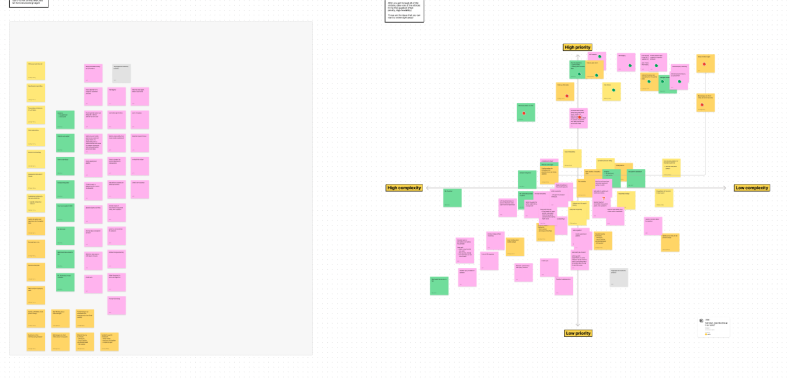
Card sorts are one of my preferred methods for understanding and aligning on priorities. We used this tool more on the analysis end of our research to break down and prioritize our findings. We typically ran our card sorts to refine our roadmap by taking research findings, recent feedback and internal ideas and sorting them into what had a high priority for both the customer and our team.
What We Made
General Research Findings
Before launching into the final product, these are some of the general themes guiding my hand that were derived from the research performed during my time at klarity.
Collaboration is essential
We identified three areas that user personas were craving a better way to collaborate: Seller - Buyer, Seller - Seller, and Buyer - Buyer. So creating strong opportunities for these users to collaborate is a no-brainer.
Buyer motivations are a mystery
I was surprised to learn that most sales reps do not have a strong signal into what their buyers are actually interested in. Unlocking those insights will unlock potential for sales teams across the board
Barrier to entry MUST be low
Online buyers are often hesitant to engage with a product like ours. This is due to data privacy concerns, mistrusting the validity of the source, and unknown reward:friction ratio. Finding ways to keep the barrier to entry low while still creating a sense of security is critical.
People REALLY don’t like sales reps
It might seem obvious, but it didn’t matter if we were talking to sales or buyers, every time this came up as a concern. Providing an experience that keeps contact from sales minimal and highly targeted is the core of our product.
Sales teams need constant training
This was another theme that I wasn’t initially aware of, but as I learned more it became more obvious. With high churn, ever-changing products, and constantly refined strategies/materials it only makes sense that sales teams are constantly training and re-training.
Say Hi to KAI, Klarity AI
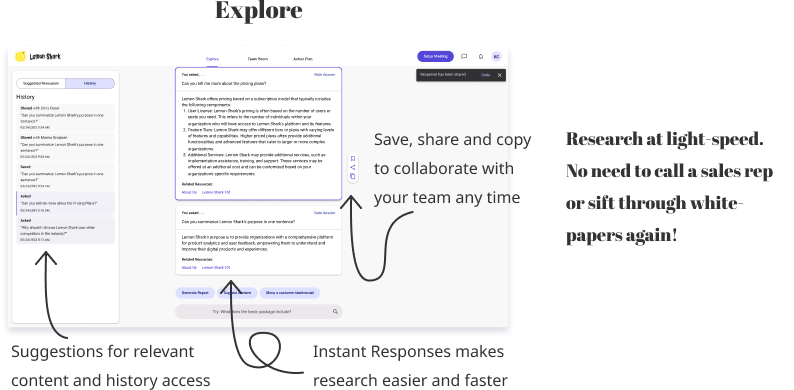
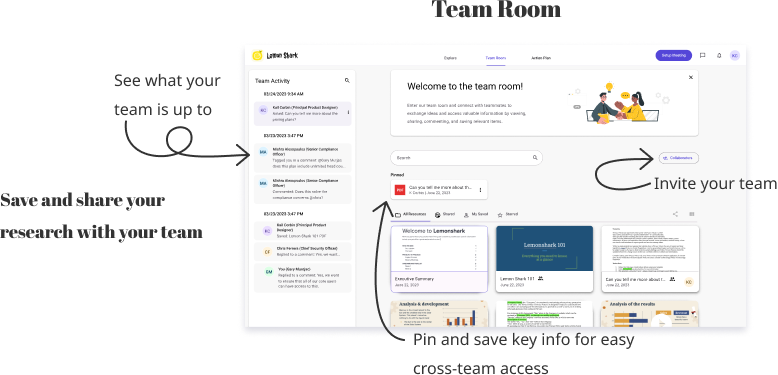
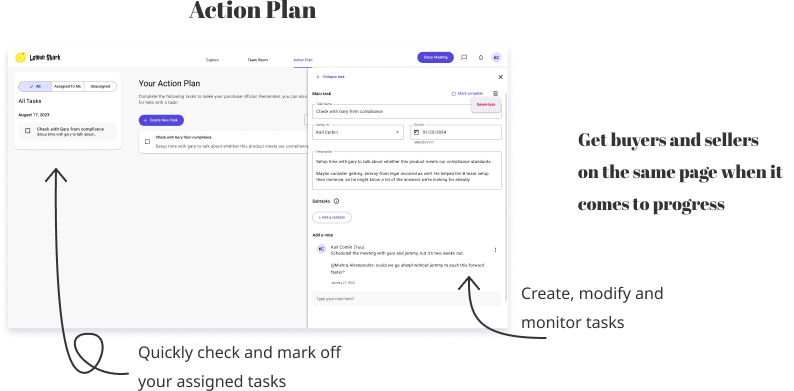
Highlights
KAI isn’t just for buyers
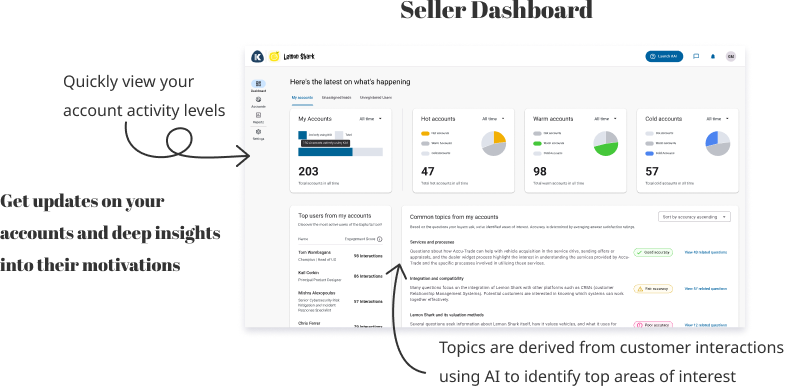
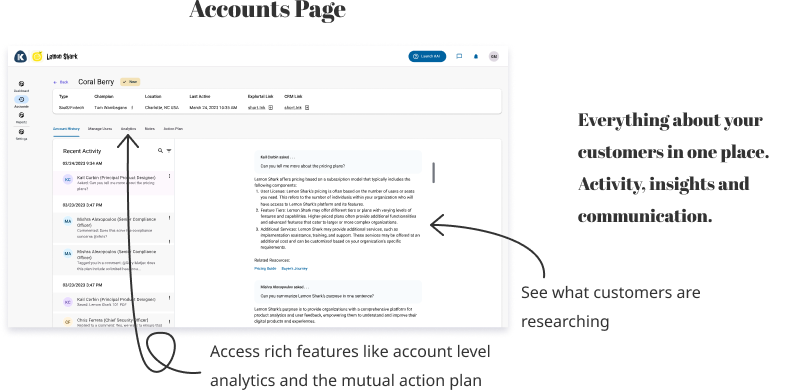
I advocated for expanding Klarity AI beyond its original scope of serving online buyers to include client teams. This decision represented a significant pivot from our initial focus solely on online buyers. However, recognizing the frequent need for sales team retraining and the challenges of staying current with product changes, we identified the tool's potential value for client teams. To facilitate seamless access, we integrated the tool into our client-facing portal as a slide-out feature, ensuring accessibility without interrupting the user's workflow.
Too much data is as bad as no data
When we first demonstrated our tool to a potential client they were captivated about the idea of seeing what buyers were researching. For the first time their team would have deep insight into buyer motivations. Subsequently, I learned many potential clients have hundreds of accounts in their sales pipeline, rendering the sheer volume of AI history overwhelming. So I pitched the concept of using common themes as the primary way to present customer insights to lower cognitive load and focus the users attention more effectively.
Getting users in to the tool is as important as the efficacy of the tool
We spent a lot of time refining our core tool and adding more powerful features to address new user stories. But, I constantly worried about users not being willing to engage with the tool. Notably, investors, upon trying the tool, swiftly transitioned from interest to excitement, reinforcing my hypothesis about potential buyer response. To mitigate potential barriers to engagement, I proposed a plan to provide many more touch points into the product. We fast-tracked the introduction of the widget version and developed various touch points, coupled with offering diverse configurations for account creation to ease user onboarding.
Conclusion & Learnings
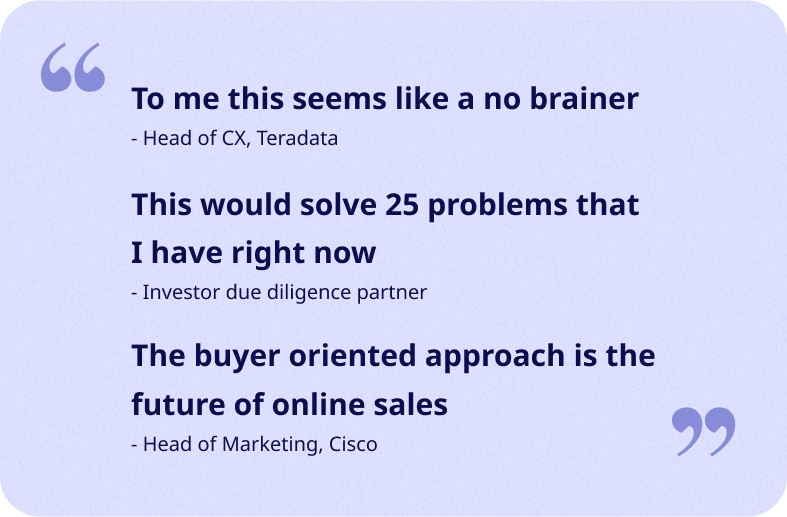
Our team developed an innovative AI-driven platform aimed at revolutionizing online sales processes. By embedding our product onto client websites, online buyers could receive instant, AI-powered responses, as if they had a sales rep by their side. Our tool facilitated seamless collaboration among buyers, salespeople, and internal teams. Despite raising nearly 1 million in funding and achieving around 50K ARR with three paying customers before launch, the company closed just three weeks after going live due to funding concerns.
During my time at Klarity, I gained invaluable insights into the importance of continual user feedback. We iteratively refined our roadmap based on fresh insights, resulting in a more polished and intuitive user experience with each sprint. I also came to appreciate the necessity of “killing your pretties”, as we had to strategically decide which features to include given our team size and resources. This often meant shelving exciting ideas to focus on enhancing the overall user experience.

